
Most businesses don't fail at AI because the technology is too hard. They fail because they start in the wrong place. They pick something flashy, spend weeks on it, and get a demo that impresses no one and saves nothing. The teams that win start small, pick one painful, repetitive process, and prove value in weeks. Here's how to find that first process.
You don't need an AI strategy deck to get started. You need one good candidate. This is the exact filter we walk clients through before we build anything.
Start with what already hurts
The best first automation is boring on purpose. Look for a task that is:
- High volume. It happens dozens or hundreds of times a week, not once a quarter.
- Repetitive and rules-based. A person does roughly the same thing each time.
- Costing you money right now, in missed calls, slow responses, manual data entry, or overtime.
- Owned by one team, so you don't need six departments to agree before you can ship.
If a task checks those four boxes, it's a candidate. If it's rare, judgment-heavy, or spread across five systems no one controls, save it for later.
A quick test
Ask your team one question: "What do you do every day that you wish you didn't have to?" The answers are your shortlist. The task people complain about most is usually the one with the clearest payback.
Score your candidates in ten minutes
Once you have three or four candidates, rank them on two axes: how much time or money it costs today, and how hard it would be to automate. You want high cost and low difficulty. That's your first project.
Common high-value starting points
- Answering and routing inbound calls so no lead goes to voicemail.
- Following up with leads within seconds, not hours.
- Pulling data between systems that someone currently copies by hand.
- Answering the same customer questions your team types out fifty times a week.
- Turning documents, emails, or forms into structured records your team can actually use.
Why starting small wins
A narrow first project does three things a big one can't. It ships in weeks, so you see real results before you lose momentum. It's cheap enough to be low-risk. And it teaches you how your own business responds to automation, which makes the second and third projects far easier to scope.
The goal of the first build isn't to transform your whole company. It's to earn trust with a clear, measurable win, then compound from there.
Not sure where to start?
That's what we do first with every client: a short, honest look at your business to find the one process worth automating now, before anyone writes a line of code. No pressure, no jargon.
Get a scoped estimateThe bottom line
You don't need to automate everything. You need to automate the right one thing first. Find the task that's high volume, repetitive, and already costing you money, prove the value in weeks, and let the results decide what comes next. That's how AI actually pays off, one clear win at a time.
Frequently Asked Questions
What business process should I automate with AI first?
Start with a task that is high volume, repetitive and rules-based, already costing you money, and owned by a single team. Answering inbound calls, following up with leads instantly, moving data between systems, and answering repeat customer questions are common high-value starting points. Rank your candidates by cost today versus difficulty to automate, and pick the one with high cost and low difficulty.
Why do so many AI projects fail?
Usually not because of the technology, but because they start too big or in the wrong place. Teams pick something flashy, spend weeks on it, and end up with a demo that saves nothing. Starting narrow, with one painful and measurable process, lets you prove value in weeks and build momentum for the next project.
How long should the first AI automation take to show results?
A well-scoped first project should ship in weeks, not months. The point of the first build is a clear, measurable win, not transforming your entire company. Once you see real results, the second and third projects are much easier to scope and justify.
Ready to Transform Your Business?
See how AI automation can help scope practical workflow improvements and measurable business-case assumptions.
Book Operations ReviewAbout HummingAgent Team
Written by the HummingAgent team. HummingAgent is a Denver-based AI consulting company that designs, builds, and runs custom AI systems for businesses across the United States, and won the TMC 2025 AI Agent Product of the Year award. The team is led by a former Comcast Labs engineer who built production AI across 1,600 data centers and 40,000 technicians.
Popular implementation paths
Turn this AI idea into a scoped workflow
Compare the related service pages and practical guides buyers most often use after reading our AI automation articles.
Related Articles
They Didn't Want an AI Pitch. They Wanted the Job Booked. Three Questions to Ask Before Buying Any AI Tool
At The Fence Show in Las Vegas I was ready to explain how our AI worked. The contractors wanted to know whether it would book jobs and what their office would stop chasing. Here are the three questions I'd ask any vendor, including us.
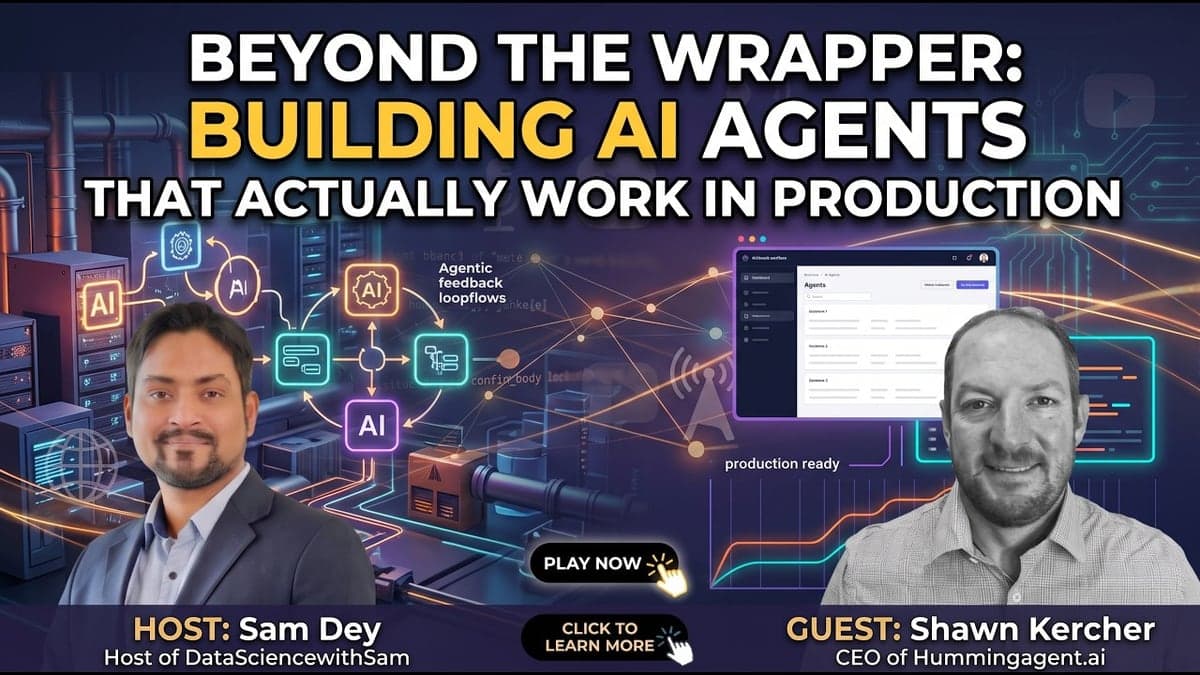
Is It an AI Agent or a ChatGPT Wrapper? One Test, and What It Takes to Build on the Right Side of the Line
Most AI products are a UI on top of a frontier model, dressed up as an agent. Here's the test: if the model provider adds this feature next quarter, does your product still exist? What I told Sam Dey on DataScienceWithSam about building things a business can run on every day.
Why Your Team Won't Update the CRM (and the Step to Remove Instead of Reminding Them)
One person told me their team relies on the CRM for everything. Another said phone messages still get written on sticky notes. Both are true. Before you send another "please update the CRM" reminder, ask whether the update is recording or copying.