
Where should finance teams use AI automation first?
Start with finance workflows that are repetitive, rules-based, and easy to review: invoice intake, vendor email triage, AP approval routing, reconciliation support, month-end close checklists, variance explanations, and management-report handoffs.
- Keep humans in approval and exception-review loops.
- Connect AI to the systems of record instead of creating another spreadsheet island.
- Measure cycle time, error rate, rework, and staff review time before expanding.
The data has been screaming the same thing since 2014, and by now, it's more than a trend—it's a systemic failure.
Every year, a new wave of tools hits the market: Cloud ERPs, RPA bots, and GenAI copilots. And every year, the same research confirms the plateau: Finance professionals still spend roughly 39% of their time on manual, automatable tasks.
It was 41% in 2014. It was 39% in 2024. And according to the latest PwC Finance Effectiveness benchmarks, the median hasn't budged. After a decade of "Digital Transformation" budgets, the needle is stuck.
So, what is actually going on? And why is 2026 the year this plateau finally breaks?
The "Trust Gap" by the Numbers
It's not for lack of trying. The stats from the current reporting cycle show a workforce that is ready, but a system that is broken:
11 Hours
Lost per finance employee, per week, to manual AP tasks alone (Tipalti)
49%
CFOs blocked from critical decisions by poor data quality (Cherry Bekaert)
96%
FP&A professionals still using Excel as their primary "integration" tool (AFP)
The gap is widening. Top-quartile companies have pushed manual work down to 24%, while the rest are still "calculating the past" instead of "shaping the future."
Why the 39% Figure Refuses to Die
If you're a CFO in 2026, you know it isn't a technology problem. It's a sequence problem.

1. Most Organizations Automate "Around the Edges"
We've replaced paper invoices with PDFs, but we haven't replaced the human who has to rename that PDF and upload it to a portal. Research from SMB Group shows that 61% of SMBs still use manual entry as their primary "integration." If you just move the friction, you haven't automated anything.
2. It's a Plumbing Problem, Not an Intelligence Problem
You can't layer AI on top of broken data. When nearly half of CFOs say poor data quality blocks their decision-making, you're looking at an infrastructure issue. You can automate a report, but if the systems don't trust each other, you're just generating wrong answers with higher velocity.
3. Excel is a Symptom of Fragmentation
Excel remains the "universal adapter" because it's the only tool flexible enough to bridge the gaps between a CRM and an ERP that don't speak the same language.
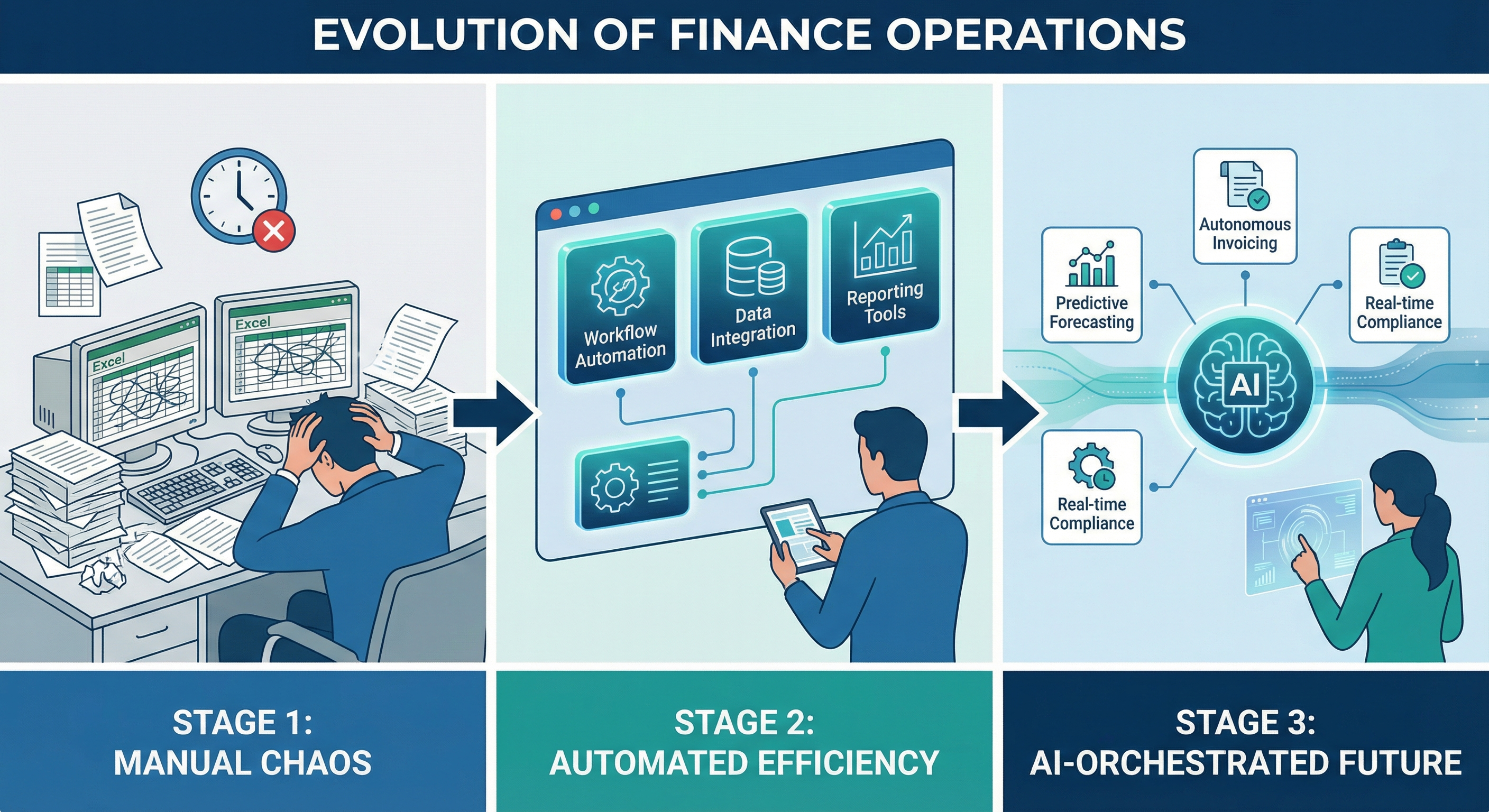
The Finance Operations Maturity Table (2026)
Where do you sit? Use this framework to self-diagnose and identify your path to the 24% Elite.
| Stage | Level 1: Manual (The 39% Club) |
Level 2: Automated (The Transition) |
Level 3: Agentic (The 24% Elite) |
|---|---|---|---|
| Data Flow | The "Human Bridge." Manual downloads, CSV cleaning, and re-uploads. |
Point-to-Point. Zapier or native integrations move data, but often break. |
Orchestrated. AI agents monitor data streams and self-correct errors in real-time. |
| Verification | Eye-Balling. A human looks at two screens to verify an invoice or record. |
Rules-Based. If-then logic flags errors, but a human must resolve every "flag." |
Autonomous. Agents cross-reference contracts/ERPs and resolve 90% of exceptions. |
| Tooling | Excel-Centric. Excel is the primary database and integration layer. |
Cloud-Siloed. Modern tools (NetSuite/Bill) are used but don't talk to each other. |
Agent-Led. Systems are connected by a "connective tissue" of intelligent agents. |
| Role of Team | Data Entry. The team spends the week gathering and cleaning data. |
Data Reviewers. The team spends the week checking the software's work. |
Strategic Catalysts. The team spends the week acting on the insights from the data. |
Most organizations recognize themselves in Level 1 or 2. The path to Level 3 starts with fixing the handoffs, not buying more tools.
Know a colleague stuck in the "messy middle"? Forward this audit to your Ops or IT lead to start mapping your own 24% elite-tier roadmap.
The 2026 Shift: From "Copilots" to "Agents"
So what's different now? Over the last two years, we've moved past simple "chatbots" to Agentic Workflows. Previous automation (RPA) was "brittle"—it broke if a pixel moved. AI agents in 2026 are different. They handle the "messy middle": the handoffs where a human previously had to reconcile two different screens.
The ROI is no longer a pilot-phase theory. Building on the foundational IDC AI Opportunity Study that showed a $3.70 return for every $1 spent, the 2026 landscape has seen that number climb even higher as we moved from simple chatbots to agentic orchestration.
A modern agentic workflow doesn't just "suggest"—it orchestrates:
- It extracts data, compares it to a contract, flags the error, and proposes the resolution.
- It operates under a Governance Layer, ensuring every decision is audit-ready and traceable—addressing the "Trust Gap" that stalled earlier AI pilots.
The Playbook for 2026
To move from the 39% median to the 24% elite, the order of operations matters:
1. Audit the Handoffs, Not the Tasks
Where does data leave one system to enter another? That is where your 39% is leaking.
2. Governance Over "Glitzy" Features
Don't implement an agent that isn't audit-ready. Traceability is the currency of 2026.
3. Measure in "Reclaimed Capacity"
The goal isn't "using AI." The goal is giving 11 hours back to your team so they can focus on high-margin strategy.
The Bottom Line
The bottleneck was never a lack of intelligence; it was a lack of connected plumbing.
In 2026, the winners won't be the ones with the most tools. They'll be the ones who finally fixed the infrastructure that's been holding their teams back since 2014.
Author's Note
"I've spent years watching talented teams get bogged down in the 'messy middle' of data. This audit isn't about replacing people; it's about replacing the grunt work so your team can finally do the work you actually hired them for."
About the Author
Ryan McCormick is Director of DevOps and AI at K3 Technologies, Denver's AI-first managed service provider, and Director of AI Engineering at Humming Agent AI, winner of the TMC AI Agent Product of the Year award. His work focuses on AI agent architecture, cloud infrastructure, and automation strategy for clients across manufacturing, legal, and government sectors.
Ready to Fix Your Finance Plumbing?
Let's audit your handoffs and find where your 39% is leaking.
Schedule a Free Consultation →Ready to Transform Your Business?
See how AI automation can help scope practical workflow improvements and measurable business-case assumptions.
Book Operations ReviewAbout Ryan McCormick
Ryan McCormick is Director of AI Engineering at HummingAgent. He is an ML engineer and researcher with experience at Comcast, Apple, and Universal Pictures, specializing in production AI systems, data pipelines, and applied machine learning.
Popular implementation paths
Turn this AI idea into a scoped workflow
Compare the related service pages and practical guides buyers most often use after reading our AI automation articles.
Related Articles
They Didn't Want an AI Pitch. They Wanted the Job Booked. Three Questions to Ask Before Buying Any AI Tool
At The Fence Show in Las Vegas I was ready to explain how our AI worked. The contractors wanted to know whether it would book jobs and what their office would stop chasing. Here are the three questions I'd ask any vendor, including us.
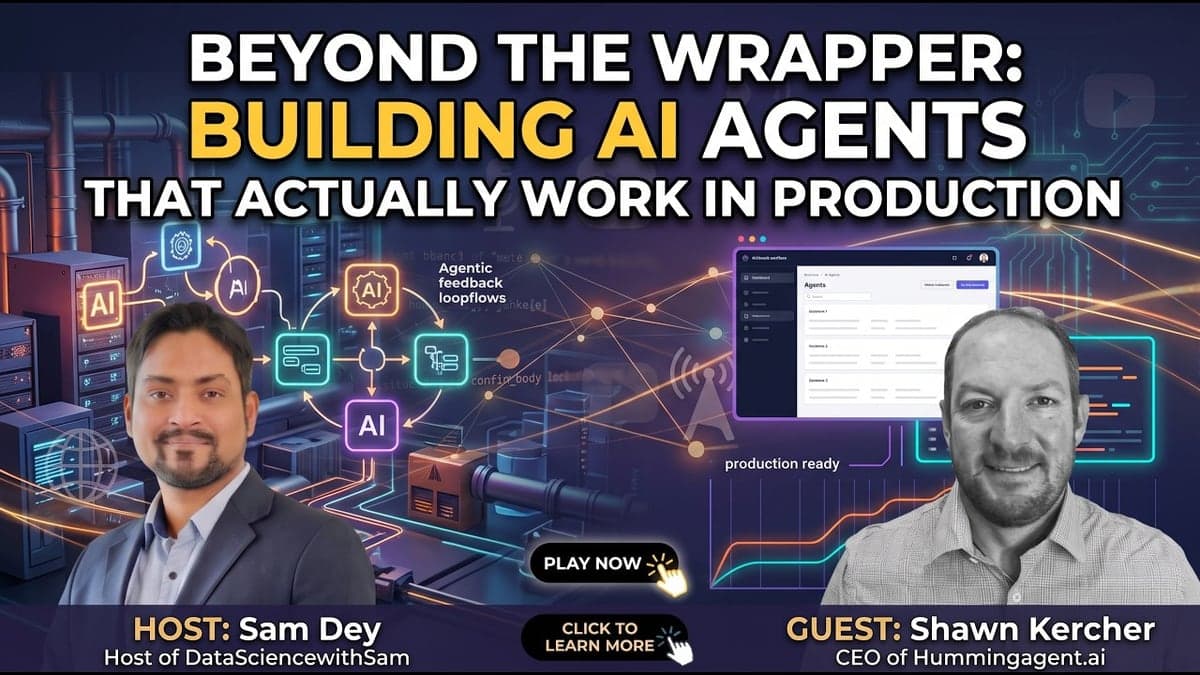
Is It an AI Agent or a ChatGPT Wrapper? One Test, and What It Takes to Build on the Right Side of the Line
Most AI products are a UI on top of a frontier model, dressed up as an agent. Here's the test: if the model provider adds this feature next quarter, does your product still exist? What I told Sam Dey on DataScienceWithSam about building things a business can run on every day.
Why Your Team Won't Update the CRM (and the Step to Remove Instead of Reminding Them)
One person told me their team relies on the CRM for everything. Another said phone messages still get written on sticky notes. Both are true. Before you send another "please update the CRM" reminder, ask whether the update is recording or copying.